
BLOG

A Red Light for Red Light Cameras
Approximately 10 minute read & Image Credit for Cover Image goes to Tobias Tullius via Unsplash.com
Poll your fellow Omaha drivers and ask if they wait a few seconds before entering an intersection once they have the green light. Or ask your pedestrian friends if crossing the street strikes them with major anxiety. The answer to both questions will most likely be “yes.”
We watch drivers run red lights habitually in Omaha, so we wondered why there aren’t any red light cameras in our city. Since face-to-face enforcement can be at best controversial and at worst dangerous, we figured most citizens would be on board with a type of enforcement that keeps everyone - drivers, cyclists, pedestrians, etc - safe. But we were surprised to find out that red light cameras are not only not allowed in the City of Omaha but will likely never be allowed in the State of Nebraska.
In this post we will cover the following topics:
the problem of running red lights,
what are red light cameras & why aren’t they allowed in Nebraska?
how can automated enforcement be improved,
civil vs criminal nature of traffic violations in Nebraska,
alternatives to automated enforcement
what you can do, and
special thanks!
Red Light Running is a Problem
According to the Insurance Institute for Highway Safety, in 2020:
928 people were killed in crashes that involved red light running
Half of those killed were pedestrians, cyclists, or people in other vehicles hit by the driver who ran the red light
An estimated 116,000 people were injured in crashes that involved red light running (1)
According to the AAA Foundation for Traffic Safety:
In 2019, deaths from red light running were at a 10 year high (2)

According to the City of Omaha’s Fatal Crash Dashboard:
Seven people have died so far this year (as of October 10, 2022) in Omaha due to a crash involving someone running a red light. (3)
One of the goals of SOS is to reduce red light running in the City of Omaha!
A few things to know about red light cameras:
Automated Enforcement
Red light cameras are categorized as automated enforcement
Automated enforcement can be a safer form of enforcement than face-to-face police stops.
Due to how some red-light programs are managed, automated enforcement may not be dangerous but it may also not be just.
Not covered by the MUTCD
Red light cameras are not considered a traffic control device so they are not included in the Manual for Uniform Traffic Control Devices (MUTCD)
The MUTCD is basically THE guidebook for licensed traffic engineers
Effective or Not?
There is a great deal of controversy and debate over the effectiveness of red light cameras
Some studies show a significant decrease in crashes, especially angled-crashes, at intersections with red-light cameras
Whereas other studies show a less significant reduction in angled-crashes but show an increase in rear-end impact crashes.
Much of the debate stems from the varied methodologies being used in the studies.
And many people cherry-pick the research they choose to cite that will best back up their belief/opinion - confirmation bias at its worst
Back to Omaha
Here’s a little background from the City of Omaha Law Department on why red light cameras are not allowed in our city:
In 1998, the City of Omaha adopted an ordinance for the detection and enforcement of traffic signal violations - otherwise known as the "red light camera" program. Shortly, thereafter, Senator Ernie Chambers filed a lawsuit against the City of Omaha seeking to enjoin the ordinance and requesting a declaratory judgment that the ordinance was invalid and unconstitutional. The District Court considered the evidence and the law and struck down the ordinance. The Court determined that the City acted outside of its authority since there was no state statute that authorized the adoption of this type of traffic ordinance. The District Court also determined that specific provisions of the ordinance dealing with fines was unconstitutional. The City decided not to appeal.
The City Law Department advised the Mayor and the City Council at that time that, in order to move forward, the legislature would have to authorize the City of Omaha to adopt this kind of ordinance. There have been a few efforts over the last 20 years to allow for automated traffic enforcement, but none have been adopted by the legislature.
Senator Ernie Chambers continued to oppose red light cameras ten+ years later in 2009 when Terry Fulton, a senator from Lincoln, introduced LB469 that would have allowed local municipalities to use cameras to issue tickets for running a red light.
Chambers was quoted in the Kearny Hub as saying:
“I guarantee I will win. This turns jurisprudence on its head.” (4)
ACLU Stance on Red Light Cameras
The American Civil Liberties Union (ACLU) is generally opposed to red light cameras. They have held this same stance for decades now as you will see in this 2001 press release “ACLU urges halt to use of red-light cameras until privacy and fairness issues are addressed - statement of Barry Steinhardt, Associate Director, American Civil Liberties Union” (5)
The ACLU is opposed to red light cameras for three main reasons:
Due process:
When tickets are sent to the owner of the vehicle that ran a red light, this assumes it was the owner of the vehicle driving. This is seen by the ACLU as an assumption of guilt, thus people could be denied the right to an assumption of innocence.
“First, the tickets are sent to the owner of a car, who was not necessarily the person committing the alleged violation. The burden of proof usually then falls on the owner to prove he or she was not driving at the time. This is a violation of the bedrock American principle that the accused be considered innocent until proven guilty.” (Ibid)
Fairness:
Many of the red-light camera contractors receive a cut of the revenue generated by tickets
“That creates an obvious incentive to contractors to "game" the system in order to increase revenue and in turn generates public cynicism and suspicion.” (Ibid)
Some communities have disproportionately concentrated red light cameras in communities of color.
Privacy:
Issues of privacy are often raised in opposition to any government surveillance.
“The ACLU is most concerned about what we call "mission creep" -- that the data collected by these cameras will be used for purposes other than tracking reckless drivers. Government and private-industry surveillance techniques created for one purpose are rarely restricted to that purpose, and every expansion of a data bank and every new use for the data opens the door to more and more privacy abuses.”
The ACLU’s stance has changed little, especially regarding privacy and cameras, as seen in this ACLU quote regarding a recent proposal to put license plate readers on City of Omaha infrastructure (the proposal was denied by Omaha City Council):
"Cameras make no distinction looking at cars. They auto-collect all data for everyone that passes through an intersection. It is mass collection of systematic data, and it is 99 percent of people innocent of nothing.”
Civil vs Criminal
Nebraska’s laws, as they relate to traffic violations, are generally criminal vs civil in nature.
Spike Eickholt, with the Nebraska chapter of the ACLU, helpfully directed me to Nebraska Revised Statute 60-682
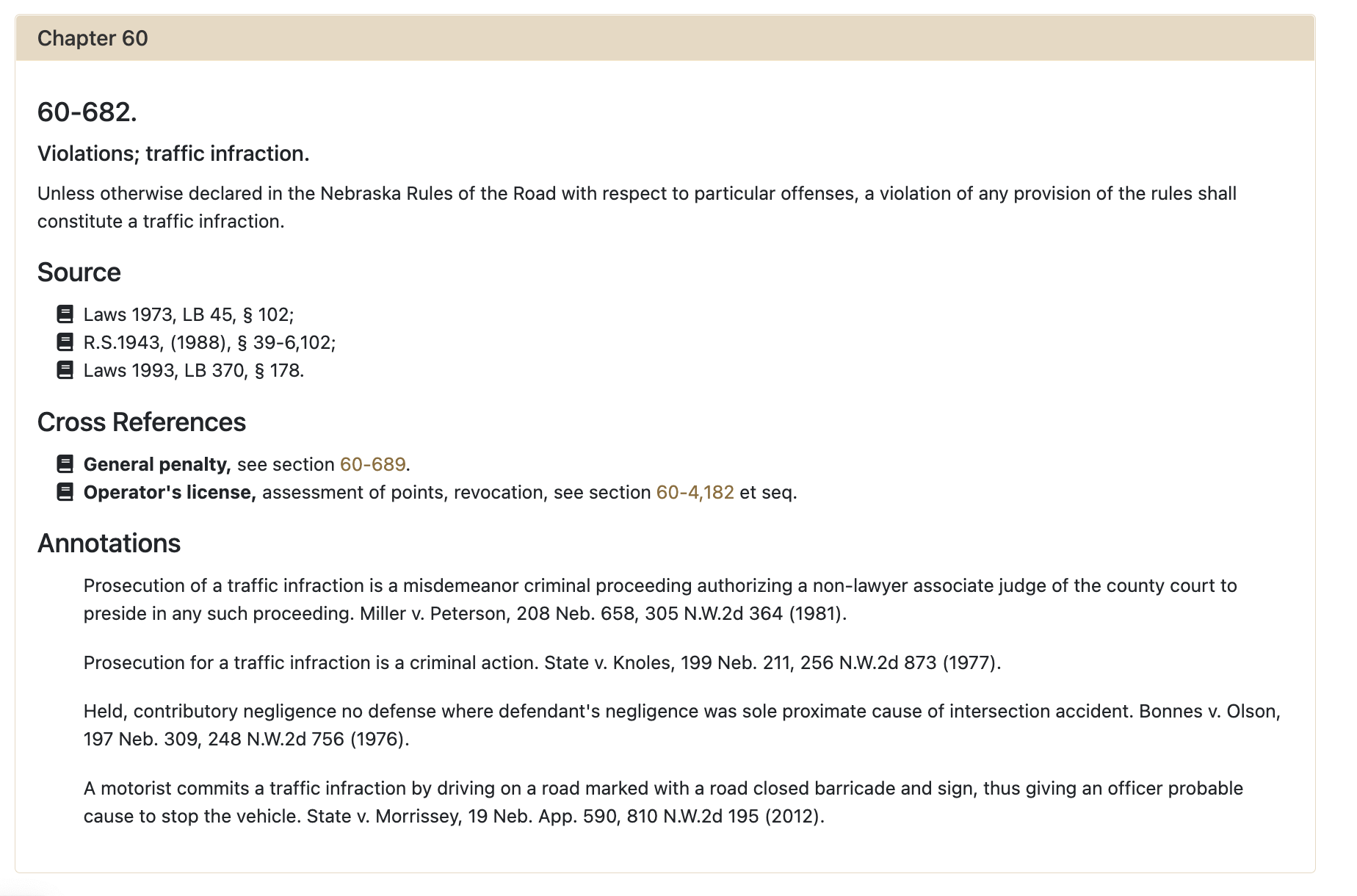
Eickholt explained,
“If you look at some of the cases that interpret this area of law you can see that our Supreme Court has said on multiple times that traffic infractions are criminal in nature.”
Even if the charge is minor, it is still considered criminal
The person being accused of the crime (running a red light) should be entitled to a presumption of innocence
This is not easily allowed for in many automated enforcement programs.
A way to Improve Red Light Camera programs
In 2021, the Insurance Institute of Highway Safety created a checklist to tackle the issues of unfairness and constitutionality in automated enforcement programs, however it does not address privacy issues. One of their first recommendations is to make design and engineering improvements to problem intersections BEFORE going the enforcement route. A few of the other approaches are listed below (8):
Locate cameras ONLY at the most dangerous intersections
Cameras should not be concentrated in communities of color
Target the Most Dangerous Violations such as blowing through a red light, not necessarily turning on a red
Use Standard Signal Timing - to prevent people claiming the yellow light timing isn’t fair, all timings must be in accordance with MUTCD
Allocate camera revenues to cover the cost of the program THEN put any additional revenue into a fund for street safety programs
Encourage public input, such as establishing an advisory stakeholder group composed of law enforcement, residents, school officials, and victims’ advocates, to help design the program and oversee changes.
Be Transparent - share all data
Don’t create monetary incentives for the camera vendors
Start the program with just warnings first, not tickets
“IIHS also says cameras should not trigger a fine for drivers who disobey the red signal less than one-eighth to one-half of a second after the light changes.”
Allow due process and an accessible way for people to contest the ticket
Offer sliding-scale fines and alternatives to payment for low-income drivers
The IIHS’ Automated Enforcement Program Checklist is a stellar tool for communities that are legally authorized to create an automated enforcement program. (9)


Alternatives to Automated Enforcement
Since red-light cameras are not an option in Omaha, here are some alternatives to automated enforcement that can help reduce red-light running.
Red-light running can be addressed via design/engineering, education, and/or enforcement.
Design/Engineering Options:
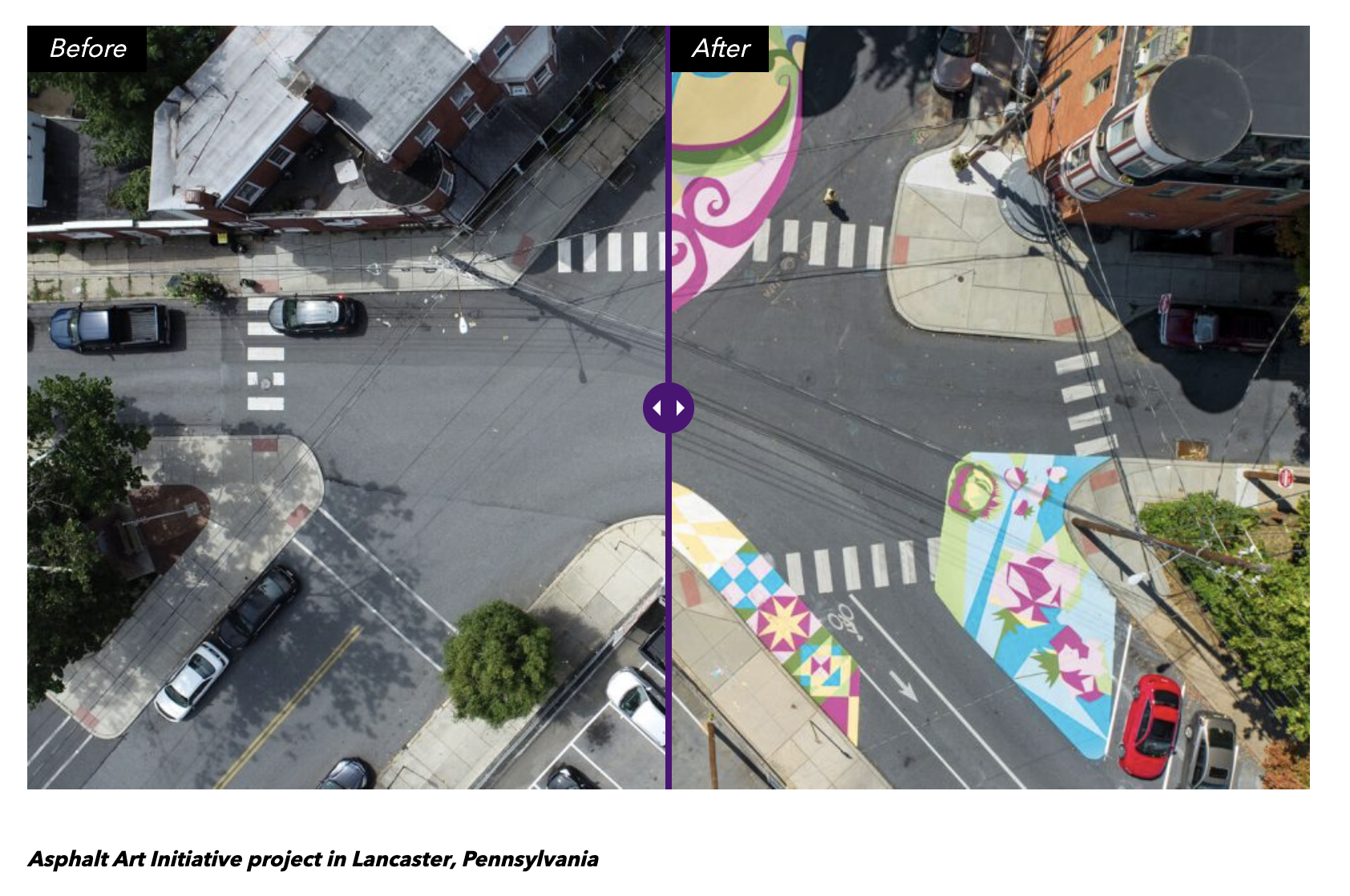
Intersection murals and street art - Not applicable in City of Omaha
Painting intersections with murals, like the one above, has been shown to reduce intersection crashes (10)
50% drop in crashes involving pedestrians or cyclists
37% drop in crashes leading to injuries
17% drop in overall accidents
You can read more about these art initiatives here
Street art is NOT allowed in the State of Nebraska because our licensed traffic engineers are required by law to be compliant with The Manual on Uniform Traffic Control Devices (MUTCD), which does not recommend street art.
I contacted Bloomberg Philanthropies,, a philanthropic organization started by former NYC mayor Mike Bloomberg, which is also the organization behind the Asphalt Art Initiative, to ask how other cities managed to conduct these creative efforts that ran askew to established traffic regulations. The person I spoke to explained that other municipalities may have a little more wiggle room in how they “interpret” the MUTCD and they may not have state statutes in place the way Nebraska does. It’s an interesting report, and I recommend reading it, but scrutinize the data as I found a few errors. The errors don’t affect their final statistical results, but they are still errors nonetheless. Also, this is not a report from an academic institution or government agency so be aware when reading about any possible bias. on the part of the authors. I’d also love to know more about the maintenance and longevity of these creative street art projects!
Roundabouts - Applied in City of Omaha

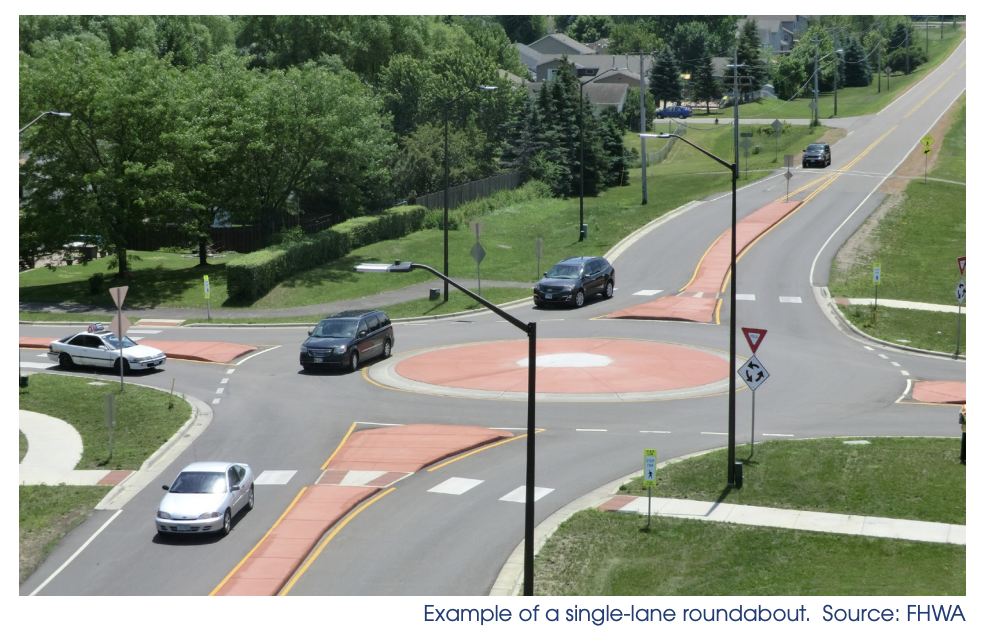
Roundabouts are a preferred engineering approach to reduce angle type crashes at intersections and to significantly decrease the severity of intersection crashes.
One of the most contested features of a roundabout is the sheer amount of land they require to be constructed which sometimes can result in a landowners losing some of their property for a public project.
Omaha’s upcoming roundabouts:
Three local signalized intersections will be transformed into safer roundabouts in the next two years.
One of the projects will be at 33rd & Hamilton streets, and is set to begin in late 2024 or possibly 2025. Once the project gets rolling, you can find updates at keepomahamoving.com
The second roundabout project will occur at two intersections (50th & 52nd) along Farnam Street. You can find out all you want to know about this project and sign up for updates here (12)
The city has already been receiving feedback at local community meetings about the need for education at roundabouts. Drivers,, pedestrians, cyclists, and all users of the roundabout must know how to safely and collaboratively navigate these no-stop intersections. Beyond any potential efforts of the city, SOS will be dedicated to advocating for signage at the actual roundabouts as well as promoting any educational campaigns.
While roundabouts are most effective, the City of Omaha has other design approaches that help reduce intersection collisions as well:
Leading Pedestrian Intervals/LPI’s - Applied in City of Omaha
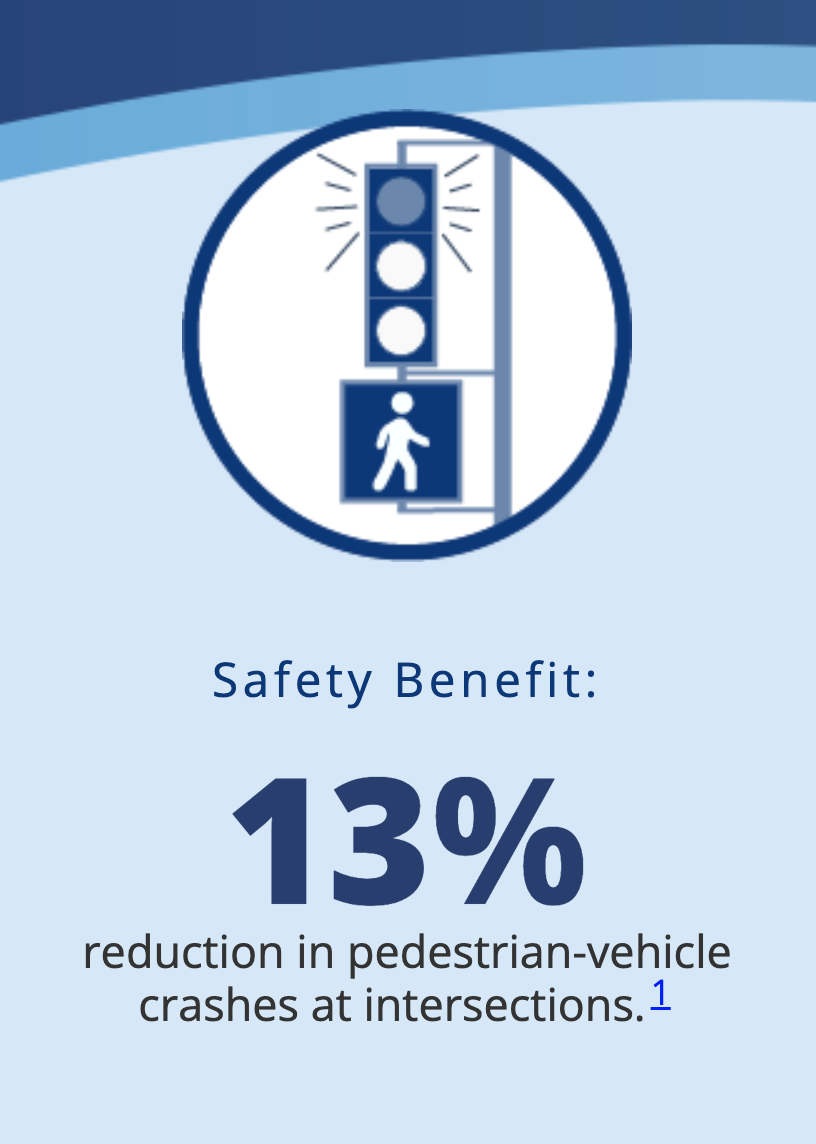
LPI’s allow a pedestrian to enter the intersection 3 to 7 seconds before vehicles are given their green light. (13)
This allows pedestrians to establish their presence in the crosswalk and can protect them from right-turning vehicles
LPI”s are new to Omaha and require upgraded equipment so they are not yet found citywide. By the end of 2022, almost half of the 1,000 signals scheduled for upgrade with have the new LPI technology.

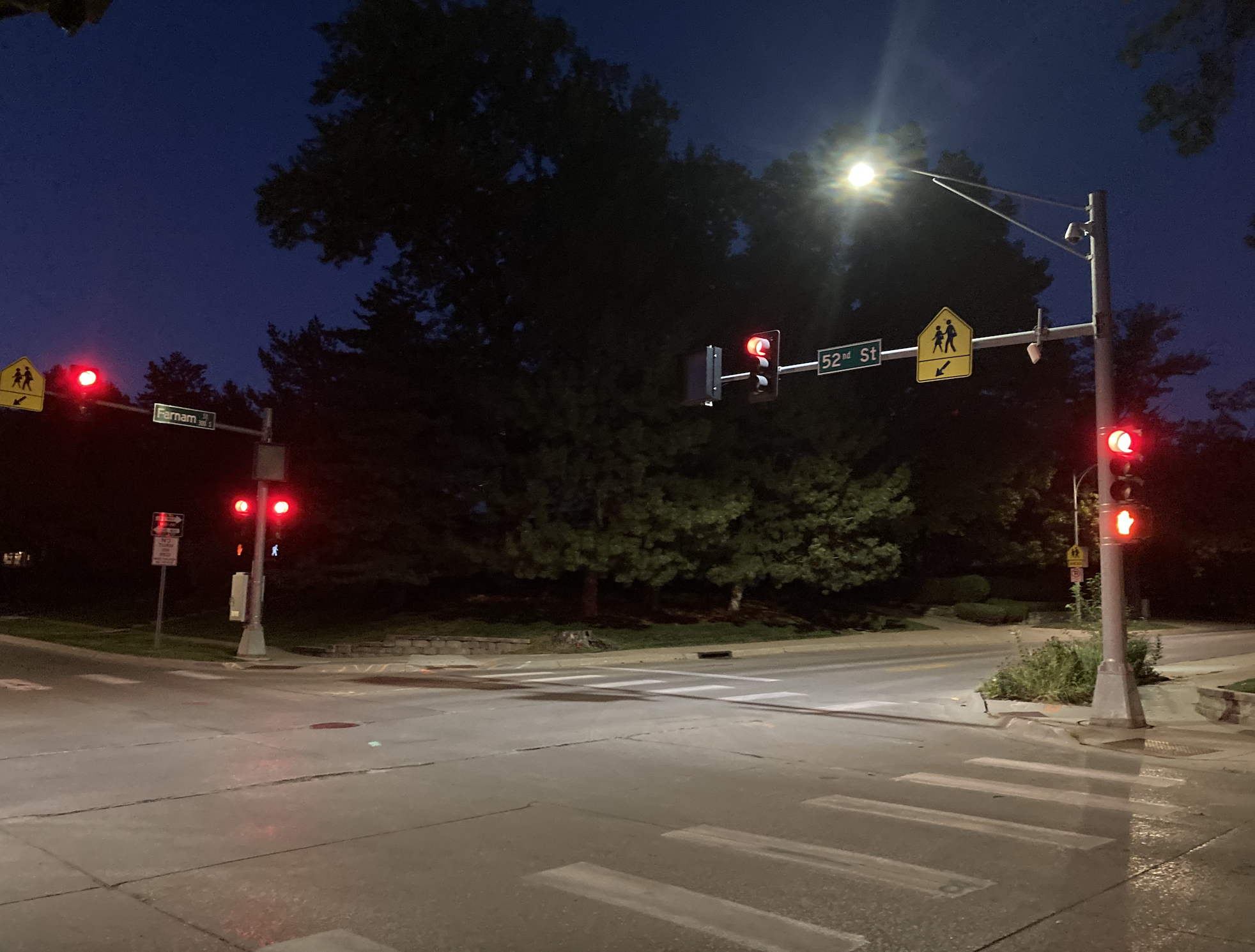
Here is a photo of an LPI in action at 52nd & Farnam
Notice how all lights are red, but the walk signal is illuminated! The city is currently working on some fun, educational videos about the new LPI’s in the city.
Retroreflective backplates- Applied in City of Omaha

This low cost strategy improves the visibility of the signal light, alerting people to a red light
Especially helpful to older and vision deficient drivers (14)
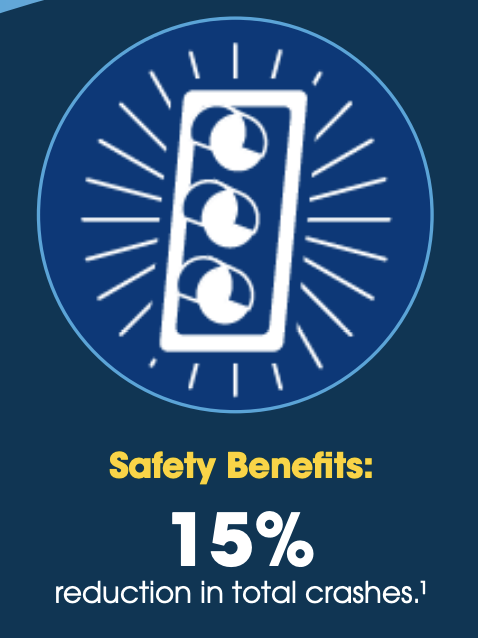
This strategy is great because it is low-cost and does result in a reduction in crashes, but is most effective when used ALONG WITH other crash-reduction strategies.

Clearance Signal Timing (Yellow/ Red Time) - Applied in City of Omaha
“The yellow change interval is the length of time that the yellow signal indication is displayed following a green signal indication. The yellow signal confirms to motorists that the green has ended and that a red will soon follow” (15)
Appropriately time yellow change intervals can not only reduce red light running but it can improve safety conditions of the overall intersection.
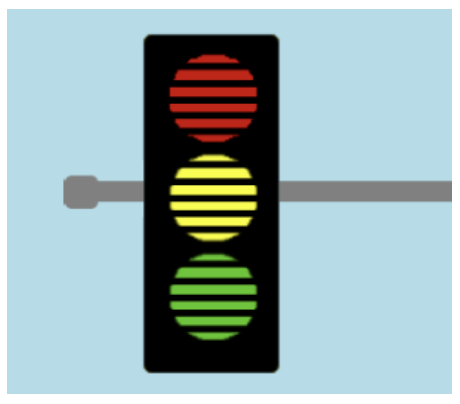
Signal Louvers - Applied in City of Omaha
These devices restrict visibility to certain lanes to prevent drivers from being distracted by adjacent signals.
The City of Omaha is currently in the midst of a Traffic Signal Infrastructure Modernization and Adaptive Signal Control Technology effort, and many of the signal strategies referenced above are included in this masterplan. Additionally, you can check out some of the traffic safety upgrades recently conducted by Public Works here.
Education
The City of Omaha is currently putting together a bunch of educational safety videos on some of the safety strategies discussed in this post. Once they become available to the public, SOS will make sure to share these with our entire network!
Beyond educational videos, check out some of the persuasive pursuits that the City of Portland’s Vision Zero initiative put together.

.
Whenever there is a deadly crash on the Streets of Portland,, the city will erect temporary visible messaging which drives home to other drivers the deadly impact of unsafe or distracted driving. This is an eye-catching way to raise awareness. (16)
The City of Portland deploys community-based Street Teams six times a year to share safe driving tips and engage with people living along Portland’s High Crash Network streets
SOS would LOVE to see the forthcoming Vision Zero Action Plan for the City of Omaha utilize ideas like the ones in Portland
Local Enforcement
Last of all options that should be employed as an alternative to automated enforcement is face-to-face enforcement.
However, if you are concerned about a local intersection you can contact your city council person and request special enforcement where the police will monitor an area and distribute citations for any unlawful behavior. While putting the public and police in face-to-face contact is a valid concern for many people, we have requested enforcement at problem intersections before.
We did this for two reasons 1) to prove to the City that an intersection of concern is dangerous and 2) to gather data.
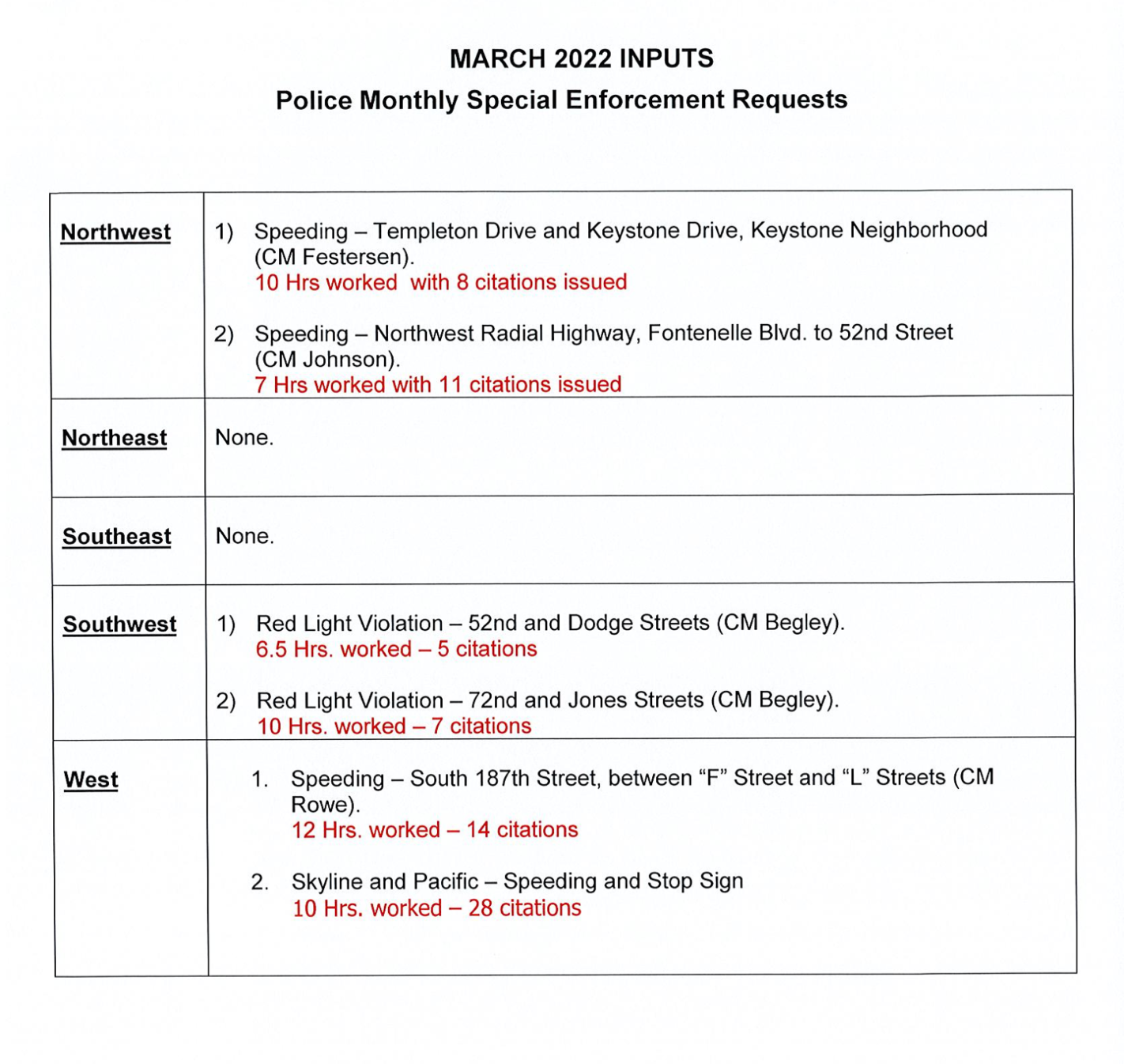
You can see from the Special Enforcement Request to the left that police issued tickets at a rate of approximately 1 citation per hour in some locations.
SOS is considering projects that would raise awareness of problem intersections while gathering data all WITHOUT involving enforcement.
One project would be a city-wide red light audit where we gather data by tallies and video, all while raising awareness of dangerous intersections. Stay tuned for that and please reach out if you are interested in participating!
WHEW! That was a lot! Are you still with us?! Check out our One Page Red Light Camera Cheat Sheet below that we prepared for you to distribute to friends, neighbors, and organizations.
We hope we answered all your questions on why we don’t have any red light cameras in the city of Omaha and some of the strategies that are being used to reduce red light running. But we have a long road ahead of us to make the streets of Omaha safe. Will you join us?
Feel free to comment below or email us at safeomahastreets@gmail.com.
Last, but definitely not least, a HUGE THANK YOU to the following people who made this gargantuan post possible:
Jeff Riesselman
Nick Gordon
Senator Megan Hunt
Christopher “Spike” Eickholt
Pell Duvall
———
References
(1) “Red Light Running.” IIHS-HLDI Crash Testing and Highway Safety, https://www.iihs.org/topics/red-light-running. Accessed 8 Oct. 2022.
(2) Allyn, Bobby. Deaths From Red Light Running At A 10-Year High, AAA Study Finds. 29 Aug. 2019, https://www.npr.org/2019/08/29/755441473/deaths-from-red-light-running-at-a-10-year-high-aaa-study-finds.
(3) City of Omaha Fatal Crash Dashboard. https://omaha.maps.arcgis.com/apps/dashboards/aaaa0a5e390646d183efe233b9758bd7. Accessed 8 Oct. 2022.
(4) Chambers Still Traffic-Camera Foe. https://kearneyhub.com/news/local/chambers-still-traffic-camera-foe/article_b865b637-189f-543b-9ae3-808e6dd6b63c.html#tncms-source=login. Accessed 8 Oct. 2022.
(5) “ACLU Urges Halt to Use of Red-Light Cameras Until Privacy and Fairness Issues Are Addressed Statement of Barry Steinhardt Associate Director, American Civil Liberties Union.” American Civil Liberties Union, https://www.aclu.org/press-releases/aclu-urges-halt-use-red-light-cameras-until-privacy-and-fairness-issues-are-addressed. Accessed 8 Oct. 2022.
(6) Ibid
(7) Omaha City Leaders Considering License Plate Reader Proposal. https://www.ketv.com/article/omaha-city-leaders-license-plate-reader-proposal/40912621. Accessed 8 Oct. 2022.
(8) Schmitt, Angie. As Cities Turn off Red Light Cameras, Red Light Runners Claim More Lives. 25 July 2018, https://usa.streetsblog.org/2018/07/25/as-cities-turn-off-red-light-cameras-red-light-runners-claim-more-lives/.
(10) “New Study Shows Streets Are Safer with Asphalt Art.” Bloomberg Philanthropies, https://www.bloomberg.org/blog/new-study-shows-streets-are-safer-with-asphalt-art/. Accessed 8 Oct. 2022.
(11) https://highways.dot.gov/sites/fhwa.dot.gov/files/2022-08/14_Roundabouts_508.pdf
(12) Farnam Street Two-Way Conversion: 50th and 52nd Street Intersection Improvements (OPW 53844) :: Keep Omaha Moving. http://www.keepomahamoving.com/projects/farnam-street-two-way-conversion-50th-and-52nd-street-intersection-improvements-opw-53844. Accessed 8 Oct. 2022.
(13) Leading Pedestrian Interval - Safety | Federal Highway Administration. https://safety.fhwa.dot.gov/provencountermeasures/lead_ped_int.cfm. Accessed 8 Oct. 2022.
(15) https://highways.dot.gov/sites/fhwa.dot.gov/files/2022-06/15_Yellow%20Change%20Intervals_508.pdf
(16) Message Boards About Traffic Deaths | Portland.Gov. https://www.portland.gov/transportation/vision-zero/message-boards. Accessed 8 Oct. 2022.

An Interview with Tom Everson, Founder of Keep Kids Alive Drive 25
One of the goals of Safe Omaha Streets (SOS) is to educate the citizens of Omaha about safe driving. When I recently met with Tom Everson, founder of Keep Kids Alive Drive 25 (KKAD25), he was the one who educated me. Tom and I met on a Tuesday morning at Blue Line coffee, where he arrived early wearing his green KKAD25-branded polo and laden with colorful visual aides. A former teacher, he is still an educator at heart. Tom is one of the most enthusiastically positive and collaborative people I have met in a long while.
As we were scheduling our interview, Tom was preparing to climb Pike’s Peak to train for the Keep Kids Alive Drive 25 “Live Forward” team that runs in honor of those who died in car crashes. This sanctioned event draws premier mountain runners from all over the world. You will see through this interview that improving road safety and people’s quality of life is not just a day job for Tom, it is his entire life ethic.
How It All Began
KKAD25 started in 1998 when Tom was on a run through his kid-heavy neighborhood and the phrase “keep kids alive drive 25” popped into his head. Since that time, he’s built an ambitious non-profit that has made positive impacts on road safety in over 1,700 communities in 49 states. One of the misconceptions I had about KKAD25 was that it was strictly a local non-profit. While it is Omaha-based, it is national in scope. In the State of New Jersey alone, Tom has brought the mission of KKAD25 to over 100 communities.
From the very beginning Tom was dedicated to using evidence-based strategies to slow down speeders. He used this same data-driven approach with the now-iconic KKAD25 signs. At this point in the interview, Tom stopped to remind me that these signs were and continue to be intended as a “friendly reminder, not an accusation.” You’ll find if you spend more than a few minutes with Tom that friendly openness is a core aspect of his personality.
Tom credits the original idea for putting the KKAD25 logo on yard signs to Lieutenant Vacek (now retired) of the Omaha Police Department. To test the effectiveness of Lt. Vacek’s idea, Tom had a prototype sign made up for his yard and conducted a small observational study where he’d look for brake-lights on cars as they passed his yard. He even conducted these observations from the window of his living room so his presence wouldn’t influence the behavior of drivers. Over a 20 month period, 75% of the cars he observed applied their brakes when passing the KKAD25 sign. Being that an earlier traffic study showed the average rate of speed in his neighborhood was 31 mph in a 25 mph zone, he believed the signs made a difference and decided to implement this idea on a larger scale.
At this point, if you aren’t well versed in traffic studies, you may be asking yourself, “whats the big deal if someone goes a few miles over 25 mph in a neighborhood?” Tom reiterated what I have heard countless times from my partner Jim, the “death rate for a car hitting you at 30 mph is 3 times higher than if the car was only going 25 mph." And like Tom said “I don’t want to get hit by a car going at any speed!”
Relationships
Every KKAD25 project is driven by the tenets of “positivity” and “relationships.” Tom was emphatic when he said “I follow the positive energy and don’t waste my time on negativity.” Basically he won’t try and change minds but will provide all the tools, help, resources, and facilitation to the people who DO want to slow down speeding drivers and make streets safer for kids.
Tom also explained that at its core, KKAD25 is about “relationships.” The guiding question behind what he does is “who do you love and who loves you?” From the standpoint of pedestrians, cyclists, and drivers, the answers to these two questions are all the reminders people need to keep themselves and others safe.
“It’s all relational,” said Tom as he continued to cleverly remind me that “it’s hard to put a face on infrastructure, so you have to put a face on how you behave and operate in that infrastructure.”
Education & Behavior Change
Tom constantly emphasized that education is integral to any behavior change, and behavior change is often needed to keep kids safe. Ever a student of human behavior, Tom also conceded that “acquiring a new skill takes patience and practice.” He offered this personal anecdote to illustrate:
Tom was sitting in the passenger seat as his son drove to football practice. After Tom witnessed his son slowly roll through a stop sign without really looking or coming to a complete stop, Tom asked why his son behaved this way. His son replied, “no one was even there.” Tom then gifted his son with a sports analogy, “you go to practice and run drills over and over again so that you are prepared for the big game. The same is true with stop signs; you practice stopping correctly day after day so that you are prepared to stop when you NEED to stop, like when a kid darts out in front of you or a driver stops short.”
This sports analogy was a powerful educational anecdote for me, especially being that I am a driver who has only been coming to a complete stop for the last 5 or so years.
Community Outreach
I asked Tom “how do you take that stop sign anecdote and extrapolate it to the community?” His answer to my question would be a recurring theme throughout the interview; “community.”
“The key to everything lies in two things: it’s the people in the communities who know what the issues are, and the solutions are within them but they just need the creativity and space for the solutions to come to the fore.”
It’s just this space that KKAD25 helps provide through network connections and facilitation.
Tom believes that projects that are built from the ground up, by the people actually living in the communities, are the best projects because they make streets safer while also building community ownership.
Highland Park, MI
One such example of this occurred in Highland Park, Michigan where the community took an arts-based approach to KKAD25 by inviting local artists to redesign the yard signs and personalize them to their community. (An example of one of these signs is the cover photo for this post) In addition to this, Highland Park also engaged local artists to design and paint a street mural as a traffic-calming strategy at an intersection with a high collision rate. Tom referenced a recent study that showed that street art can reduce crashes between motorists and other road users by 50%! The street mural was just recently finished so Tom will have to wait for the evaluation phase of the project, but he ended his story by saying “Street art is reclaiming space in a creative way” (1)
After I applauded Tom for his impact in Highland Park, he characteristically and humbly removed himself as the focus and said “I let others create, I just facilitate.”
Oro Valley, Arizona
Another effective safety campaign that was built from the community up was the origination and distribution of KKAD25 trash decals. It is illegal to place any signage - including KKAD25 signs - within the public right of way, so Tom was intrigued in 1999 when he received a call from a retired traffic engineer in Southern California who suggested Tom make KKAD25 decals that could be displayed on trash bins. The traffic engineer explained that not only would these decals avoid the ROW issue, but they’d also help all the neighbors send the same safety message once a week to all drivers.
The decal project became a popular campaign for KKAD25 with the clever title of “America’s Trash Talks to Keep Kids Alive.” The first community to ever participate in the Trash Talks campaign was Oro Valley, Arizona in August of 1999. A study was conducted on those initial decals, and a 13.5% reduction in speed was noted not only on days the decals were displayed but also on days when the bins were not curbside. Tom referred to this type of campaign as a “passive approach to safety,” meaning that speeds were reduced WITHOUT issuing tickets or reengineering a roadway; it was strictly community engagement. “They engaged the community and the community made change”
Omaha, NE
Prior to the City of Omaha’s new waste and recycling contract, Tom tried hard to partner with the City to implement the KKAD25 “Trash Talks to Keep Kids Alive” campaign. While he said he had the verbal support of Mayor Stothert, the partnership ultimately, and unfortunately, did not come to fruition.

But you can purchase decals for your yourself or your neighborhood association via the KKAD decals page.
Here’s a photo of Tom showing off one of these decals.
What About Omaha?
Once Tom told the tale of the trash bin decals in Omaha, I asked him what he thinks about the current state of community engagement in Omaha. His response was thoughtful and encouraging.
“One of the challenges for a city is to recognize there are so many partners out there that need to be drawn into the process. You can’t build something from the ground up by going out and saying ‘This is our plan and you are going to be a part of it.’ For our city to be successful, it ultimately hinges on engaging the grassroots representation of the community to give it a uniquely Omaha feel.”
While he did praise the Omaha Police Department for its continued support of KKAD25, Tom hopes that the new Vision Zero initiative and forthcoming VZ Action Plan process, will help to garner more community engagement around street safety and speed reduction.
Beyond Progress to Participation
Similar to Jeff Sobczyk’s comments in our inaugural SOS interview, Tom also believes we need to encompass more progressive thinking in Omaha. However, he then made this surprising and thought provoking statement:
“Progressive to me means NOT always looking at what worked in other cities. No solution or campaign has to be homogenous - different parts of the city have different issues.”
True change can only happen when you engage the people living in the communities, and this truly is a theme not just in KKAD25 but in Tom’s life as well. He is, as he says, a “connector,” and this statement couldn’t be truer. He remembers every project and community he’s worked with, and always gives credit to the ideas that did not originate with him. Not only does he make an imprint on communities, but the people in those communities make an imprint on him. And I don’t believe this would be possible if Tom didn’t adhere to one of his personal mantras of “be a listener, not a dictator."
After our interview, Tom emailed me about a local partnership between KKAD25 and Children's Hospital through the Safe Kids Coalition which created co-branded yard signs and trash can decals that will be distributed at community events. Visit the KKAD25 website and listen to their podcast to keep up on both the ongoing and newly launched campaigns and projects.
Wrap Up
As we wrapped up our time together, I posed this last question to Tom,
“What is your final piece of advice or guidance to the citizens of Omaha, advocacy organizations, etc?”
Tom left with me this,
“A lot of us have heard of the power of One. If we are waiting for somebody else to do something then probably very little will get done, but if we realize - as we are driving or riding - that our power lies in what we can take control over, this will help people be safe. Ask yourself ‘what is in my power to do?”
This approach can manifest itself in something as simple but life-saving as stopping at stop signs and red lights.
Tom ended where he began, with talk of building relationships; “go find somebody who is positive and spread the word because your story will resonate with others, that’s where the momentum and the ripple effects begin.”
Thanks to Tom for all his time and knowledge. Beyond founding KKAD25, Tom was also the head of the City of Omaha’s Vision Zero Task Force which ultimately recommended the City hire a Vision Zero coordinator. Visit the KKAD25 website for a comprehensive understanding of all their amazing safety initiatives and order signs and decals for your neighborhood to start your own KKAD25 safety campaign!
~ Thanks for reading, and if you found this post informative, then Please Share It!
(1) The Manual on Uniform Traffic Control Devices (MUTCD) does not recommend street art be used on any public roads and provides no exception for intersection murals or street art. Licensed traffic engineers are regulated by State regulations to adopt and follow the MUTCD. Additionally, the City Law Department has advised that Public Works remain compliant with the MUTCD. Thus, unless something changes at the federal level in the MUTCD, Omaha cannot legally allow for intersection murals, etc. The City does allow for bike lanes to be painted green, as evidenced by the Harney Bikeway. I plan to do an in-depth post about Street Art & Regulations so stay tuned!

Are Red-light Cameras Viable in Omaha?
This is an introductory piece to an upcoming post titled “A Red Light for Red Light Cameras in Omaha.” Stay tuned for that upcoming post and email us at safeomahastreets@gmail.com to sign up for our newsletter where we highlight a new blog post in every issue!
——-
Have you ever wondered why there aren’t any red-light cameras (aka automated enforcement) in the City of Omaha?
Well up until last week, I incorrectly assumed that the reason for this was some type of insufficient progress on the part of the City of Omaha. I was wrong! It turns out, we’d need a change at the State level to even consider using red-light cameras as a tool of non-contact enforcement.
Read this passage from the city’s Law Department for a summary of the issue:
In 1998, the City of Omaha adopted an ordinance for the detection and enforcement of traffic signal violations - otherwise known as the "red light camera" program. Shortly, thereafter, Senator Ernie Chambers filed a lawsuit against the City of Omaha seeking to enjoin the ordinance and requesting a declaratory judgment that the ordinance was invalid and unconstitutional. The District Court considered the evidence and the law and struck down the ordinance. The Court determined that the City acted outside of its authority since there was no state statute that authorized the adoption of this type of traffic ordinance. The District Court also determined that specific provisions of the ordinance dealing with fines was unconstitutional. The City decided not to appeal. The City Law Department advised the Mayor and the City Council at that time that, in order to move forward, the legislature would have to authorize the City of Omaha to adopt this kind of ordinance. There have been a few efforts over the last 20 years to allow for automated traffic enforcement, but none have been adopted by the legislature.
I had no clue! But now we know.
A tenet of SOS is to educate the citizens of Omaha on all things street-safety, and eradicate any existing misconceptions.
———-
Cover image by Veron Wessels via Unsplash

Conversation with Jeff Sobczyk, Omaha’s Vision Zero Coordinator

Did you know that Omaha has a dedicated Vision Zero Coordinator?
Do you even know what Vision Zero is?
Keep reading for an enlightening conversation with Jeff Sobczyk, our own VZ Coordinator!
SOS Question 1: In 2018, Mayor Stothert made a commitment for Omaha to become a Vision Zero city and initiated the Vision Zero Task Force. Following the Task Force’s recommendations, the city hired you in December of 2020 as the City of Omaha Vision Zero Coordinator. For those who don’t know what Vision Zero is, can you share a brief explanation?
Jeff Sobczyk Reply: Put simply, it is a data-driven strategy to eliminate all traffic fatalities and severe injuries* on our public roads. This strategy requires a major change in how we think about travel and the transportation system as a whole.
When a city commits to Vision Zero it is stating that traffic-related deaths and serious injuries are no longer acceptable side effects of the road system. There is no acceptable number of lives lost other than ZERO. The safety of ALL users is the top priority moving forward.
SOS Question 2: As Vision Zero coordinator, you will support and implement the Vision Zero Action Plan. It is my understanding that the City of Omaha is in final negotiations with the consultant who will ultimately develop this plan. Can you tell us more about that process, and the timeline and purpose of the Action Plan?
Jeff Sobczyk Reply:
Negotiations with our consultant are finished, and we are identifying internal funding. Once City Council approves the contract we are looking at a mid to late September 2022 start on the action planning process. With full support from Major Stothert, the Vision Zero Action Plan (VZAP) will lay the foundation needed for creating and sustaining a new culture of safety in Omaha.
The VZAP will be a living document that provides a framework that all agencies/departments within the City can utilize to align efforts and form the partnerships required to be successful to reach the goal of zero. During the planning process, we will be driven by data to help inform decision-makers on how best to utilize limited resources and prioritize decisions to achieve the greatest safety benefit.
With all of the data analysis, internal meetings, workshops, focus groups, and public engagement, we expect to have this document completed by September of 2023.
SOS Question 3: One of the reasons we started SOS now is to build on the momentum of Vision Zero. As the City moves forward with its commitment to VZ, what opportunities will there be for the public to be involved?
Jeff Sobczyk Reply:
There will be ample opportunities for the public to be engaged as well as involved with the process. We not only need public feedback, but we also need public support and buy-in to the culture change needed for Vision Zero to be a sustained success. That is why we plan on being at public events where we can engage the public about Vision Zero, educate them about its goals and gather public input to help drive our action plan. Toward the end of the process, we will give the general public an opportunity to review our draft plan and provide valuable comments so our plan can be as strong as possible.
SOS Question 4: Some of the major problems I see on our roads are red-light running, variable speed driving, improper merging, and distracted driving. In what ways have Vision Zero projects in other cities addressed problems like these?
Jeff Sobczyk Reply:
Vision Zero is a key departure from the old way of looking at traffic safety, one in which the goal was to prevent all crashes. The paradigm shift that VZ provides is an acknowledgment that humans are prone to mistakes. Roadway designers and policymakers who have the most influence on systemic change are tasked with creating an adaptable and forgiving transportation system that takes human failings into consideration so that when a crash happens, it is not fatal, or severe.
To accomplish such a system, one of the main goals must always be speed management. To do so, Vision Zero cities look at all available traffic calming (slowing) options that make the road user feel like they need to pay attention to the road and their surroundings in order to safely arrive at their destination.
This will range from prioritizing complete street designs, building roundabouts, road diets, narrowing road widths, reducing intersection turn radii, building speed humps in strategic locations, and investing more in speed feedback technologies.
Many of these strategies are already used to various extents in Omaha today. We will need to double down on such practices that are known to work and also be bold and seek out other innovative traffic calming strategies being implemented successfully nationwide.
SOS Question 5: The Vision Zero action plan is expected to be complete by September 2023. Until then, what can we do as citizens to promote safe roads for all?
Jeff Sobczyk Reply:
That is a great question. I would suggest talking to your family, friends, neighbors, etc. about what Vision Zero is and why it is important. When our VZAP is finished we will have our own website to educate and inform the public about VZ and our efforts. Until that time, guide people to the Vision Zero Network Website which has countless resources to help educate anyone on this vital topic.
Continue to promote other safety campaigns that share similar safety goals as Vision Zero, such as
The National Safety Council's "Head Up, Phone Down" campaign,
Omaha's "Zip It" campaign,
Project Extra Mile which works to prevent and reduce alcohol-related harms in Nebraska, and
Nebraska Department of Transportations Buckle Up, Phone Down, and many others.
What is at the core of Vision Zero and all of these other safety campaigns, is the message that we need to all be aware of the problem(s), start working together, and commit as a community to create a shared culture of safety.
SOS Question 6: What are you most passionate about regarding safe roads?
Jeff Sobczyk Reply:
I am passionate about the fact that safe roads/transportation is vital to a good quality of life. At the end of the day, the roads we use to go about our daily lives, are public assets. Regardless of what mode of transportation you use, regardless of your income, where you live, your age, or physical ability; roads should be designed and maintained to encourage safe and equitable use by all.———
A huge “Thank You” to Jeff for taking the time to get us all up to speed on Omaha’s Vision Zero Action Plan. Keep up with the City of Omaha and SOS for notification of any VZ public events.
If you have any questions on Omaha’s commitment to Vision Zero, you can contact Jeff at: City of Omaha Public Works - Traffic Division, 1819 Farnam St, Suite 603, Omaha, NE 68183. Telephone: 402-444-5237 and email Jeff.Sobczyk@cityofomaha.org

Jeff Sobczyk, Vision Zero Coordinator
Thanks for reading!
Emphases throughout interview added by author

Just Zip It!
August 8, 2022
I was raised in Omaha and thus learned to drive in Omaha. And like many native Omahans, I used to merge like a moron. Until about 6 years ago, I was the a**hole who would queue up in one long line of traffic and wouldn’t let anyone in from the other lane. At the time, I believed the drivers in the lane that was about to end were being rude, so I wielded my politeness with an aggressive hand.
I was clueless that merging late is merging safe. The most efficient and safest way to merge is by using BOTH lanes of traffic and waiting to merge until the actual merge point. Even the Federal Highway Administration agrees:
In typical lane reduction situations, drivers often attempt to merge into the appropriate lane as soon as possible, which can lead to potentially unsafe driving behavior such as slowing too quickly, excessive braking, or dangerous lane changes. Additionally, much of the lane that’s ending remains unused prior to the merge area.
Although an early merge may be safe, or even ideal, at lower speeds with lighter traffic flow, a later merge can be beneficial in managing unsafe driving behavior at higher speeds and/or when the traffic flow is heavier. (1)
The City of Omaha ALSO WANTS YOU TO MERGE PROPERLY! Did you know that the City of Omaha designed a public outreach campaign called “Just Zip It!” The campaign encourages and educates people about how to merge properly in construction zones. Check out their website for videos, resources, and tips on merging properly.
Here’s a sneak preview of some of the information you’ll find there:
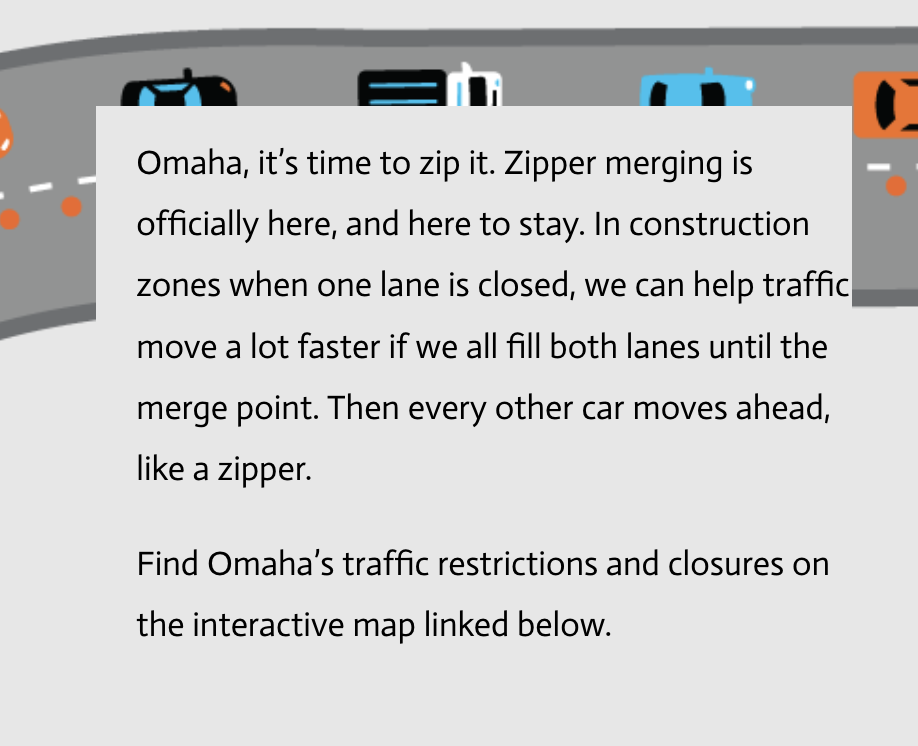
This great website needs more traffic, and the people of Omaha need more driving education, so please share the Just Zip It website on your social media platforms and via email!
It is my understanding that the public launch of this campaign was delayed due to the Covid-19 pandemic of 2020. Let your representatives and City administrators know that you’d like this public education campaign to be formally distributed!

The folks behind the Just Zip It! campaign designed decals for the citizens of Omaha to use on their cars as a show of zipper merge support.
Please contact Jeff Sobczyk, the Vision Zero Coordinator for the City of Omaha, for Just Zip It! decals while they last. Jeff.Sobczyk@cityofomaha.org
I still have a couple dozen decals as well, so you can also contact me at safeomahastreets@gmail.com and I will send you decals like the one in the photo to the left!
Safe Omaha Streets wants to build on the momentum of existing safe-driving initiatives like the Just Zip It! campaign. And if the city doesn’t have time or funds to distribute it, we will!
Thanks for reading!
(1) https://highways.dot.gov/research/projects/sign-guidance-zipper-merge