
BLOG

Conversation with Jeff Sobczyk, Omaha’s Vision Zero Coordinator

Did you know that Omaha has a dedicated Vision Zero Coordinator?
Do you even know what Vision Zero is?
Keep reading for an enlightening conversation with Jeff Sobczyk, our own VZ Coordinator!
SOS Question 1: In 2018, Mayor Stothert made a commitment for Omaha to become a Vision Zero city and initiated the Vision Zero Task Force. Following the Task Force’s recommendations, the city hired you in December of 2020 as the City of Omaha Vision Zero Coordinator. For those who don’t know what Vision Zero is, can you share a brief explanation?
Jeff Sobczyk Reply: Put simply, it is a data-driven strategy to eliminate all traffic fatalities and severe injuries* on our public roads. This strategy requires a major change in how we think about travel and the transportation system as a whole.
When a city commits to Vision Zero it is stating that traffic-related deaths and serious injuries are no longer acceptable side effects of the road system. There is no acceptable number of lives lost other than ZERO. The safety of ALL users is the top priority moving forward.
SOS Question 2: As Vision Zero coordinator, you will support and implement the Vision Zero Action Plan. It is my understanding that the City of Omaha is in final negotiations with the consultant who will ultimately develop this plan. Can you tell us more about that process, and the timeline and purpose of the Action Plan?
Jeff Sobczyk Reply:
Negotiations with our consultant are finished, and we are identifying internal funding. Once City Council approves the contract we are looking at a mid to late September 2022 start on the action planning process. With full support from Major Stothert, the Vision Zero Action Plan (VZAP) will lay the foundation needed for creating and sustaining a new culture of safety in Omaha.
The VZAP will be a living document that provides a framework that all agencies/departments within the City can utilize to align efforts and form the partnerships required to be successful to reach the goal of zero. During the planning process, we will be driven by data to help inform decision-makers on how best to utilize limited resources and prioritize decisions to achieve the greatest safety benefit.
With all of the data analysis, internal meetings, workshops, focus groups, and public engagement, we expect to have this document completed by September of 2023.
SOS Question 3: One of the reasons we started SOS now is to build on the momentum of Vision Zero. As the City moves forward with its commitment to VZ, what opportunities will there be for the public to be involved?
Jeff Sobczyk Reply:
There will be ample opportunities for the public to be engaged as well as involved with the process. We not only need public feedback, but we also need public support and buy-in to the culture change needed for Vision Zero to be a sustained success. That is why we plan on being at public events where we can engage the public about Vision Zero, educate them about its goals and gather public input to help drive our action plan. Toward the end of the process, we will give the general public an opportunity to review our draft plan and provide valuable comments so our plan can be as strong as possible.
SOS Question 4: Some of the major problems I see on our roads are red-light running, variable speed driving, improper merging, and distracted driving. In what ways have Vision Zero projects in other cities addressed problems like these?
Jeff Sobczyk Reply:
Vision Zero is a key departure from the old way of looking at traffic safety, one in which the goal was to prevent all crashes. The paradigm shift that VZ provides is an acknowledgment that humans are prone to mistakes. Roadway designers and policymakers who have the most influence on systemic change are tasked with creating an adaptable and forgiving transportation system that takes human failings into consideration so that when a crash happens, it is not fatal, or severe.
To accomplish such a system, one of the main goals must always be speed management. To do so, Vision Zero cities look at all available traffic calming (slowing) options that make the road user feel like they need to pay attention to the road and their surroundings in order to safely arrive at their destination.
This will range from prioritizing complete street designs, building roundabouts, road diets, narrowing road widths, reducing intersection turn radii, building speed humps in strategic locations, and investing more in speed feedback technologies.
Many of these strategies are already used to various extents in Omaha today. We will need to double down on such practices that are known to work and also be bold and seek out other innovative traffic calming strategies being implemented successfully nationwide.
SOS Question 5: The Vision Zero action plan is expected to be complete by September 2023. Until then, what can we do as citizens to promote safe roads for all?
Jeff Sobczyk Reply:
That is a great question. I would suggest talking to your family, friends, neighbors, etc. about what Vision Zero is and why it is important. When our VZAP is finished we will have our own website to educate and inform the public about VZ and our efforts. Until that time, guide people to the Vision Zero Network Website which has countless resources to help educate anyone on this vital topic.
Continue to promote other safety campaigns that share similar safety goals as Vision Zero, such as
The National Safety Council's "Head Up, Phone Down" campaign,
Omaha's "Zip It" campaign,
Project Extra Mile which works to prevent and reduce alcohol-related harms in Nebraska, and
Nebraska Department of Transportations Buckle Up, Phone Down, and many others.
What is at the core of Vision Zero and all of these other safety campaigns, is the message that we need to all be aware of the problem(s), start working together, and commit as a community to create a shared culture of safety.
SOS Question 6: What are you most passionate about regarding safe roads?
Jeff Sobczyk Reply:
I am passionate about the fact that safe roads/transportation is vital to a good quality of life. At the end of the day, the roads we use to go about our daily lives, are public assets. Regardless of what mode of transportation you use, regardless of your income, where you live, your age, or physical ability; roads should be designed and maintained to encourage safe and equitable use by all.———
A huge “Thank You” to Jeff for taking the time to get us all up to speed on Omaha’s Vision Zero Action Plan. Keep up with the City of Omaha and SOS for notification of any VZ public events.
If you have any questions on Omaha’s commitment to Vision Zero, you can contact Jeff at: City of Omaha Public Works - Traffic Division, 1819 Farnam St, Suite 603, Omaha, NE 68183. Telephone: 402-444-5237 and email Jeff.Sobczyk@cityofomaha.org

Jeff Sobczyk, Vision Zero Coordinator
Thanks for reading!
Emphases throughout interview added by author

Just Zip It!
August 8, 2022
I was raised in Omaha and thus learned to drive in Omaha. And like many native Omahans, I used to merge like a moron. Until about 6 years ago, I was the a**hole who would queue up in one long line of traffic and wouldn’t let anyone in from the other lane. At the time, I believed the drivers in the lane that was about to end were being rude, so I wielded my politeness with an aggressive hand.
I was clueless that merging late is merging safe. The most efficient and safest way to merge is by using BOTH lanes of traffic and waiting to merge until the actual merge point. Even the Federal Highway Administration agrees:
In typical lane reduction situations, drivers often attempt to merge into the appropriate lane as soon as possible, which can lead to potentially unsafe driving behavior such as slowing too quickly, excessive braking, or dangerous lane changes. Additionally, much of the lane that’s ending remains unused prior to the merge area.
Although an early merge may be safe, or even ideal, at lower speeds with lighter traffic flow, a later merge can be beneficial in managing unsafe driving behavior at higher speeds and/or when the traffic flow is heavier. (1)
The City of Omaha ALSO WANTS YOU TO MERGE PROPERLY! Did you know that the City of Omaha designed a public outreach campaign called “Just Zip It!” The campaign encourages and educates people about how to merge properly in construction zones. Check out their website for videos, resources, and tips on merging properly.
Here’s a sneak preview of some of the information you’ll find there:
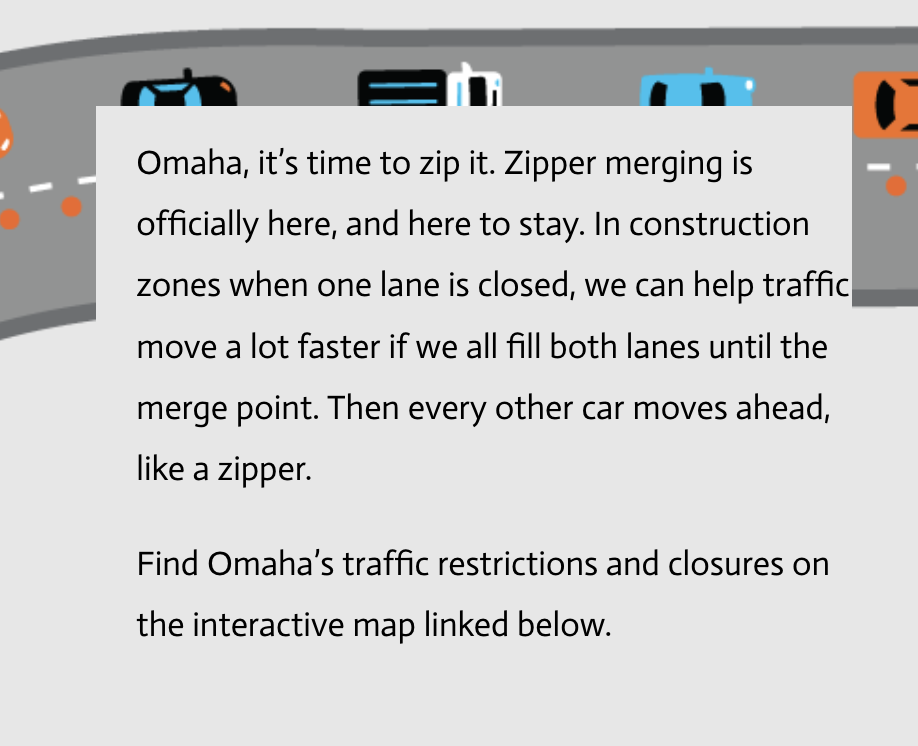
This great website needs more traffic, and the people of Omaha need more driving education, so please share the Just Zip It website on your social media platforms and via email!
It is my understanding that the public launch of this campaign was delayed due to the Covid-19 pandemic of 2020. Let your representatives and City administrators know that you’d like this public education campaign to be formally distributed!

The folks behind the Just Zip It! campaign designed decals for the citizens of Omaha to use on their cars as a show of zipper merge support.
Please contact Jeff Sobczyk, the Vision Zero Coordinator for the City of Omaha, for Just Zip It! decals while they last. Jeff.Sobczyk@cityofomaha.org
I still have a couple dozen decals as well, so you can also contact me at safeomahastreets@gmail.com and I will send you decals like the one in the photo to the left!
Safe Omaha Streets wants to build on the momentum of existing safe-driving initiatives like the Just Zip It! campaign. And if the city doesn’t have time or funds to distribute it, we will!
Thanks for reading!
(1) https://highways.dot.gov/research/projects/sign-guidance-zipper-merge