On the evening of Thursday, 26 March 2026, I walked into Benson High School, on North 52nd Street, to attend a public open house hosted by the City of Omaha for the “Corridor Study for Military Avenue, NW Radial Highway, & Cuming Street” project.
Per the City’s KOM site, “The purpose of this project is to improve safety for all users, walkability, and multi-modal opportunities along the Nebraska Highway 64 / Link Highway 28-K corridor of Cuming Street (28th Street to Northwest Radial Highway), Northwest Radial Highway (Cuming Street to Military Avenue/ 63rd Street), and Military Avenue (Northwest Radial Highway/ 63rd Street to 70th Avenue).”
If you weren’t able to attend the meeting last month, you can still make your voice heard. The City is asking for public comment on this study by April 25. You can comment here.
A Little Bit of Background. . .
This much-needed corridor study has been in the works for years. It was nearly three years ago, in June 2023, when the Omaha City Council approved funds for the study, a decision which was well-covered in the local newsmedia.
At that 2023 city council meeting, the council passed a resolution detailing an agreement between the City of Omaha and the Nebraska Department of Transportation. The city agreed to be responsible for a 20% local cost share of the total $375,000 project, with NDOT responsible for the balance. Thus, the city agreed to pay $75,000 for its part of this study. NDOT is also responsible for reviewing and approving all steps of the project. Its involvement is due to the fact that two of the roadways in the study area are designated state highways. After that resolution was passed, the City began selecting a consultant to work on the study.
Many large-scale, city-level studies and projects that you may have read about (i.e., Vision Zero) are not completed by city staff alone but involve paid consultants who work at the behest of their client, the City of Omaha. It wasn’t until I attended the open house that I found out the local consultant for this corridor study is Felsburg, Holt & Ullevig (FHU). When attending open houses or public meetings such as this, remember that there can be BOTH city staff AND consultants in attendance, and it’s always smart to understand who you are talking to and which entity they represent, because City staff often have a deeper, more historic understanding of the project.
Another important thing to remember is that this “corridor study” project is just that, a study. The end of this project will result in a study, not in actual construction. I’m not dismissing the importance of studies, simply clarifying that this project, at this point, is just that; a study. An additional point of clarification is that this study will not identify a “final” plan or alternative, but is more of a feasibility study. To best clarify this complex project, I reached out to Nick Gordon (Nicholas Gordon/City of Omaha, Public Works, P.E., PTOE, RSP1), the project manager for this corridor safety study. I’ve known Nick for about four years. He is gracious, thoughtful, and always generous with his time and knowledge. Since we are usually sitting down in meetings when we see each other, I was surprised by his height at the public meeting. Granted, I’m short, but I never realized how tall he really is, and I believe that may be due to his welcoming, helpful, and affable personality.
In an email correspondence from 2023 (see, this project has been a long time in the making!), Nick clarified that this study would identify safety projects and their cost estimates along this corridor. Because of the involvement of state highways, NDOT would have to approve any projects. Once the parameters of the projects are finalized, the City would need to secure funding for their construction. It could do this by adding projects to the Capital Improvement Plan (CIP), requesting potential funding support from NDOT, or applying for federal funding. Using federal funds can oftentimes add another 2 to 3 years to a project.
Three years later, after the public open house, I reached out to Nick again to gain a clearer understanding of how the safety alternatives (roundabouts, signal upgrades, etc) would be considered and applied. He explained that, given the scope of the area, the study will not identify a “final” alternative, but instead is more of a “feasibility study.” The goals of which would be to consider different alternatives to improve safety, assess how effective these safety alternatives would be at handling future traffic volumes, and understand any potential impacts these projects might have (such as property issues, access, etc.)
He explained it best when he wrote,
“Basically, the study is trying to answer the question, what can we do that would work and what would the public think?”
So this current study will identify a variety of potential projects, and when a project is ready to move forward, it will do so with further design refinements and additional public involvement before any final selection is made. Due to the long corridor and high associated costs, there would be a lot of different projects, ranging from quick-build to full construction.
After Nick’s clarification, I wondered how many other attendees left the open house a bit confused over the scope and purpose of this study.
Being Heard
Grand-scale projects such as these require clear communication from consultants and the city, as well as an immense amount of time and multiple phases. Thus, we are still in the early phase of this project. But the early stages are where residents and stakeholders can best make their voices heard. And being heard was the purpose of the March 26 Open House at Benson High.
When attendees entered the meeting, they were met with a sign-in sheet, a fact sheet, handouts, and two city representatives from the Public Works Department. All materials from the meeting, including large maps, poster boards, and fact sheets, can be found here on the City’s Keep Omaha Moving page. All maps of the study corridor and alternative safety concepts were printed in large format and laid out on tables for attendees to dissect and comment on via a variety of colorful adhesive notepapers. A consultant from FHU or a City representative was present at each table to answer questions and provide information. Multiple safety alternatives are being considered for this corridor. Specifically, the strategies include a blend of roundabouts, enhanced crosswalks, lane reconfigurations, corridor access management (reducing the number of access points along a corridor), safer intersections, and upgraded signals. Many of these strategies were covered in more detail on the poster boards presented at the meeting and on the KOM page.
People poured over the designs, chatting with neighbors and strangers while covering the maps in sticky notes. The interactive nature of the meeting allowed people to share their thoughts not just with the city, but also with others who live along the corridor. Neighbors know the dangers of these roadways, and their personal experiences reflect the data. From 2015 through 2023, there were 2,003 total crashes, including 9 fatal crashes and 57 serious injury crashes (per Omaha Vision Zero).
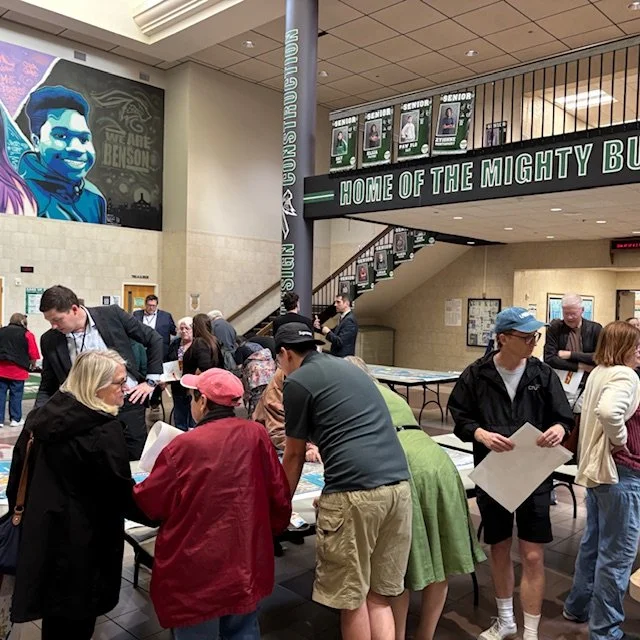
Stakeholders reviewed maps and chatted with each other, the consultants, and city staff.
The energy ranged from upbeat to desperately passionate that night.
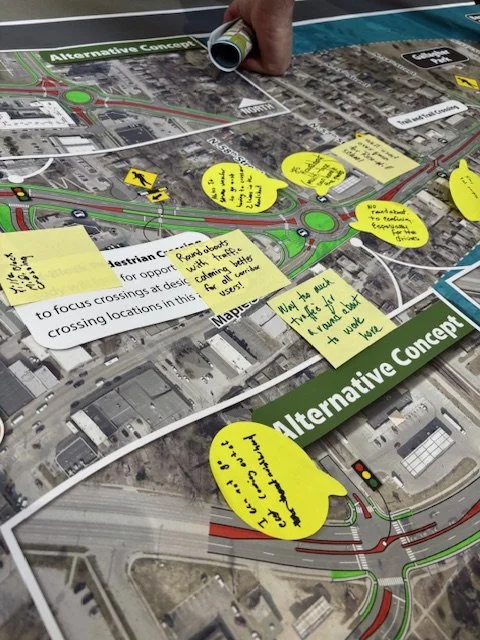
A consistent experience of the evening was the polarizing effect of roundabouts.
Two sticky notes read:
“Way too much traffic for a roundabout to work here”
and
“Roundabouts with traffic calming better for all corridor users!”
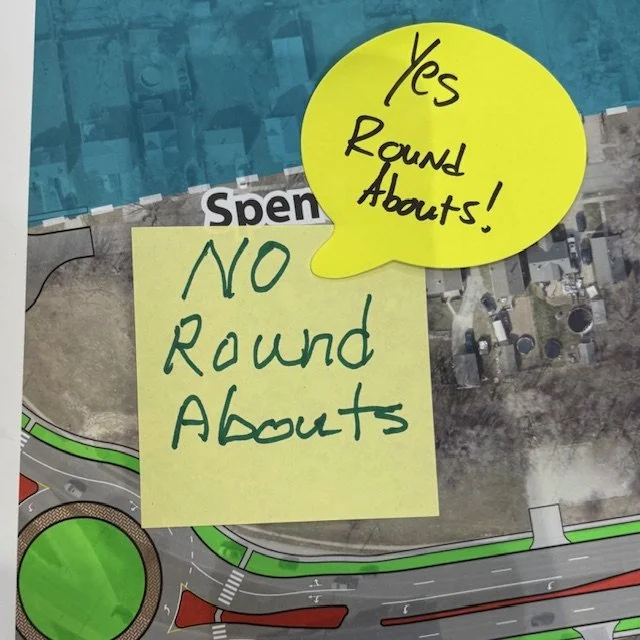
And yet, more roundabout divisiveness. . .
Does the City or SOS or another entity need to host a Roundabout Educatioinal event?! Would a fight break out?!
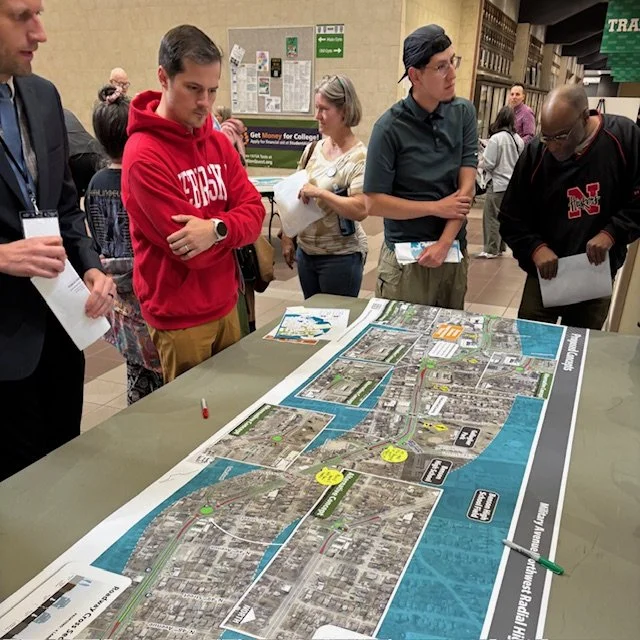
Nebraska turnout.
I’m a hockey fan, not a basketball fan, but since this open house was held the same night as a much-anticipated Husker basketball game, I was pleased to still see a strong turnout for this meeting.
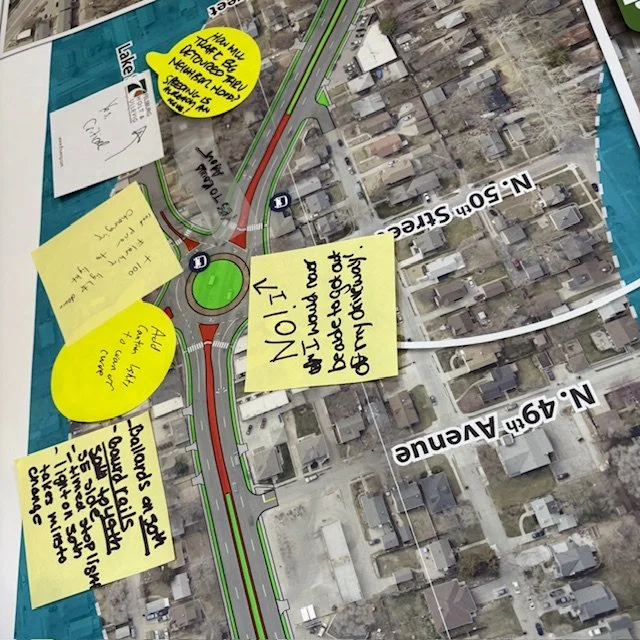
It’s personal.
You can see by the notes here that the people who attended this meeting are personally affected not only by the existing design of the corridor, but by potential future changes to the corridor. Residents are often looking at transportation through the lens of their own daily experience, not the larger lens of theory, studies, and regulations.
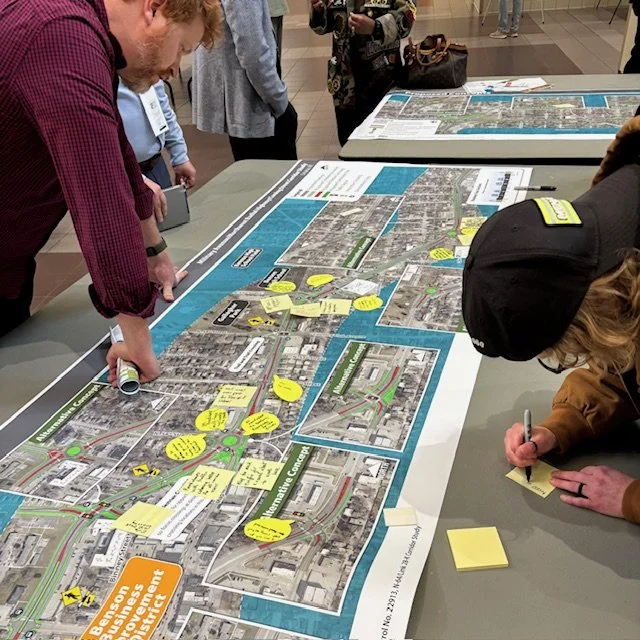
Interactive.
I appreciated how many attendees grabbed a marker and a piece of paper and truly interacted with the maps, as well as with the comments of others. By the end of the evening, the maps themselves became a living conversation.
Suggestions for Future Open Houses
If you’ve been reading our blog for long, you won’t be surprised when the content switches into op-ed territory. As I rounded the room that evening, overhearing conversations and having some of my own, I was struck by how differently each open house can be experienced depending on the consultant and the mode of public outreach. And while people were engaged and participated, I think there are some improvements that could be made to future open houses, mostly centered on clear communication, education, and opportunities for follow-up.
Docents
Beyond the maps on the tables, there were also a variety of informational poster boards around the perimeter of the room, copies of which can all be found here. The poster boards discussed everything from traffic volume to roundabouts, and some provided information specific to Vision Zero. I didn’t initially understand how these boards related to the large maps or to the project as a whole. And while the two city representatives at the welcome table provided handouts and asked people to sign in, an open house of this size, for a project of this size, could have benefited from more guidance. Specifically, it would have been beneficial to have two or three consultants serve as dedicated docents for the evening. They could greet newcomers at the entrance and provide a quick rundown of the project, the purpose of the meeting, and how best to navigate the room, given the number of poster boards and maps. The docents could also ensure attendees knew how to submit comments after the meeting, in case they missed it on the handouts. A good party needs a prepared host, and a good open house needs a few communicative docents.
Additional City Resources
Many people attend open houses such as these with concerns or ideas that may be adjacent to but outside the scope of the actual project. And it would be great to steer these people in the right direction for such concerns. Sometimes it’s as easy as displaying a poster board with a few key city resources, such as the Mayor’s hotline, City Council representatives, the Keep Omaha Moving page, the Traffic Calming Request form, the Omaha Hotline portal, etc, etc. The city has an abundance of resources, but too often residents don’t know about them or don’t know how to navigate them all. While an exhaustive list of resources wouldn’t be feasible at open houses, it may be helpful to have a poster board dedicated to highlighting and promoting any city services, departments, or projects related to the meeting.
Education & Follow-up
Having been so intimate with the transportation safety industry for a while now, I am always intrigued by the solutions that neighbors come with, and how much room there is for education, and more than that, how open they are to being educated. The gal I walked into the meeting with said she wanted speed bumps and more enforcement along this corridor. Others talked about red light cameras. Speed bumps wouldn’t be feasible on such busy roadways, and enforcement cameras are presently illegal in the State of Nebraska. I did overhear one of the FHU consultants clarify the red-light camera restriction to an attendee, but as I walked through the open house, it began to occur to me just how much of an opportunity these events are to educate residents, both at the meeting and after they’ve left for the night.
This opportunity to educate goes hand-in-hand with another idea I had that night about follow-up. Too often, people attend meetings, provide comments, and then hear nothing back, only to be told to keep an eye on a website, the news, or social media. But this can start to feel like all your ideas and opinions just get sucked into a black hole. I could see the passion and enthusiasm people had for this project, and the time and thought that went into their feedback. So shouldn’t they be kept in the loop about how the project progresses? It would be amazing if everyone who signed in to the meeting with an email address was emailed a little summary of the open house. I do not mean “reply to each comment individually,” but rather put together a one-page primer after the meeting that addresses some of the most common concerns and misconceptions heard that night. Not only would this be educational, but it would prevent people from feeling unheard. If people think speed bumps, guardrails, and red light cameras are the solution, and they include that in their comments, but are never educated on why these solutions are not feasible, then you end up with a populace that feels unheard at best, and duped at worst.
At the very minimum, people should be emailed about any progress with the project. Each time a new phase opens up or a public meeting is scheduled, the city could email prior interested parties. The onus so often falls on the resident, who is already busy, but once you have a stakeholder’s email, then the onus should fall on the city to keep residents informed and engaged. I asked one of the Public Works representatives at the welcome table if something like this would ever happen, and she said that while they are striving for a more “closed-loop” system, they just don’t have the staff at this point. So instead of instituting a blanket policy, maybe it’s worth trying once to see how it goes. And for all I know, it may just be that people end up unsubscribing and don’t care as much about follow-up as they do about feeling heard on just one evening.
Get Heard!
I relayed some of the suggestions above to Nick at the end of the meeting that night, and he let me know that he’d actually passed some of them along to their Public Involvement/Communications staff. Talk about feeling heard! And you have just a few days left to be heard, so make sure to submit your comments on this study here by April 25. Or you can also conatct Nick, the PM for this project: Nicholas Gordon, P.E., PTOE, RSP1, 402-444-5220, Nicholas.Gordon@cityofomaha.org
Lastly. . .
Overall, the vibe of the meeting was positive and passionate, and the fact that so many people are so obviously invested is always a good thing.
~ Please comment below, and thanks for reading!
Trilety Wade